Updated on
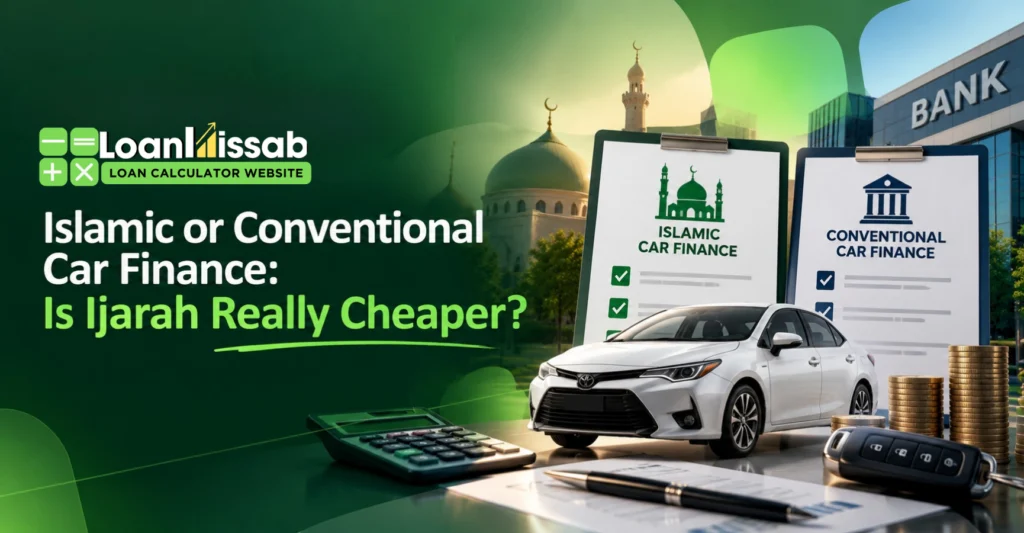
For a lot of families in Pakistan, the choice between Islamic and conventional car finance is not really about money. It is about what they are comfortable with. But many people also assume that Islamic finance must cost more, or that it must cost less. We wanted to see what the numbers actually say.
So we took one car and financed it six ways, through Islamic and conventional products, with the same down payment and the same term.
How the two contracts work, in plain words
With a conventional car loan, the bank lends you money, you buy the car in your name, and you pay the loan back with interest. If you pay late, the bank charges a late fee and keeps it.
With Ijarah, which Meezan Bank and others offer, the bank buys the car and rents it to you. Your monthly payment is rent. At the end of the term, after all payments are made, ownership is transferred to you. Insurance is replaced by takaful, and late payment charges are given to charity rather than kept by the bank as income. Some banks, like Dubai Islamic Bank and Faysal Bank, use a different Islamic structure called diminishing musharakah, where you and the bank jointly own the car and you gradually buy out the bank’s share.
Islamic banks in Pakistan price their profit rate against the same KIBOR benchmark that conventional banks use. That is why the rates end up close to each other, as you will see below.
The example we used
A Suzuki Cultus VXL at Rs 43.59 lakh. It is a 1000cc car, so the State Bank minimum down payment is only 15 percent. But 85 percent of its price is more than Rs 30 lakh, which is the most any one person can borrow for a car. So the bank finances Rs 30 lakh and you pay the remaining Rs 13.59 lakh upfront. The term is five years.
The numbers
| Bank and product | Type | Rate | Monthly payment | Total paid over 5 years | Profit or interest | Upfront fees |
|---|---|---|---|---|---|---|
| Bank of Punjab | Conventional | 14.10% | Rs 69,960 | Rs 41.98 lakh | Rs 11.98 lakh | about Rs 30,500 |
| Meezan Car Ijarah | Islamic | 14.65% | Rs 70,820 | Rs 42.49 lakh | Rs 12.49 lakh | Rs 2,500 |
| Dubai Islamic Bank | Islamic | 14.65% | Rs 70,820 | Rs 42.49 lakh | Rs 12.49 lakh | about Rs 40,000 |
| Bank Alfalah | Conventional | 14.85% | Rs 71,134 | Rs 42.68 lakh | Rs 12.68 lakh | about Rs 25,000 |
| HBL | Conventional | 15.10% | Rs 71,527 | Rs 42.92 lakh | Rs 12.92 lakh | about Rs 42,000 |
| Bank Alfalah | Islamic | 15.15% | Rs 71,606 | Rs 42.96 lakh | Rs 12.96 lakh | about Rs 25,000 |
What the numbers tell us
The cheapest option here is conventional, and the second cheapest is Islamic. Between Bank of Punjab and Meezan, the monthly difference is about Rs 860, and over five years it comes to roughly Rs 51,600 in extra profit.
But look at the fees column. Meezan’s flat Rs 2,500 compared with around Rs 30,500 at Bank of Punjab closes more than half of that gap on day one. And HBL’s conventional loan, with a higher rate and higher fees, costs more than either Islamic option.
So the honest answer is this. Islamic finance is not automatically cheaper, and it is not automatically more expensive. The difference between the cheapest Islamic and cheapest conventional option is small enough that it should not be the deciding factor for most people. The bank matters more than the type.
Other differences that can matter more than the rate
Takaful versus insurance. Both protect the car, but the premiums can differ. Ask for the first year’s takaful or insurance amount in writing and add it to your comparison.
Paying off early. Conventional banks usually charge a penalty if you settle the loan early, often a percentage of the remaining amount. Islamic banks handle early settlement differently, and some are more flexible. If you think you might pay the car off early, ask about this before you choose.
Late payments. At an Islamic bank, late payment charges go to charity. At a conventional bank, they are income for the bank. Either way, you pay them, so this is a matter of principle rather than cost.
Who owns the car. With Ijarah, the car is registered in the bank’s name until the end. With a conventional loan, it is in your name from the start, with the bank’s lien on it. This can matter when it comes to selling or transferring the car before the loan ends.
How to choose
If Islamic finance matters to you, you are not giving up much by choosing it, and you may even save money depending on the bank. If it does not matter to you, simply pick whichever bank gives you the lowest total cost after fees and insurance are included.
In both cases, ask every bank the same three questions: what is the rate, can it change during the term, and what are all the fees upfront. Then compare the totals, not just the monthly payment.
Compare both types for your car
Our Car Loan Calculator has a switch at the top for Islamic and conventional. Pick your car, flip between the two, and it compares every bank side by side, with SBP rules applied automatically.
Thinking about a different car? Our breakdown of the Alto, Yaris and City on a loan shows what each really costs to run every month.
Rates and fees were checked in September 2026 and are indicative. Banks change their rates and charges regularly, so always compare written offers before you decide.
Frequently asked questions
What is the finance charge on a car loan?
For a lot of families in Pakistan, the choice between Islamic and conventional car finance is not really about money. It is about what they are comfortable with.
Work out your car installment
- MCB Car Loan Calculator
- UBL Car Loan Calculator
- Car Loan in Pakistan 2026: Bank Rates, SBP Rules and How the Process Works
- Pakistan Car Sales Jump 107% in May 2026 — Is Now the Right Time to Take a Car Loan?