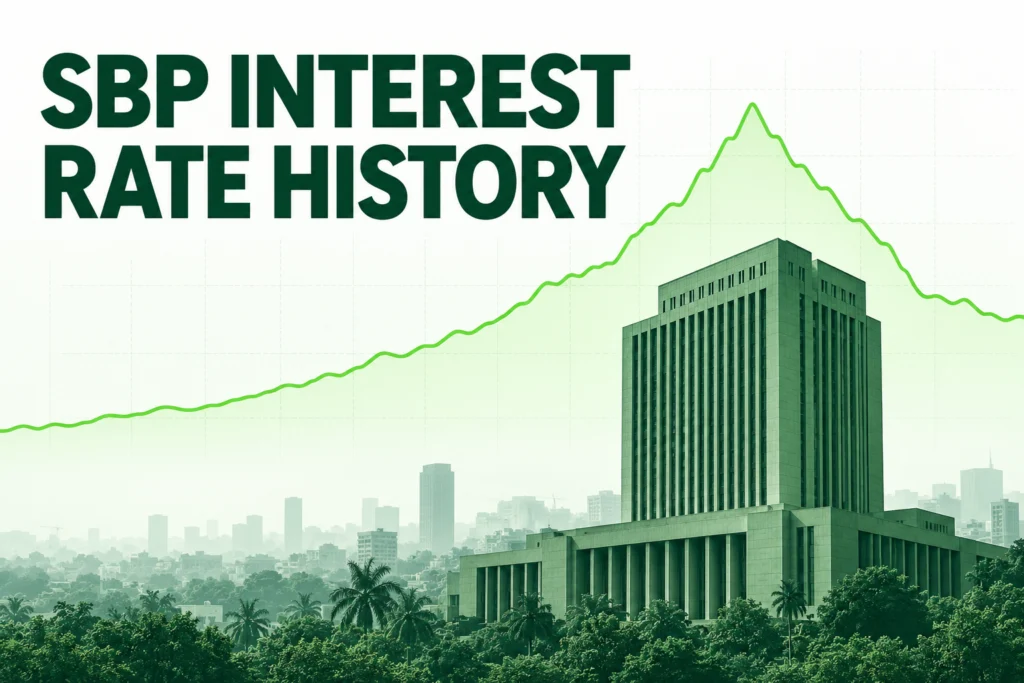
The State Bank of Pakistan’s policy rate has swung from 7% to a record 22% and back to 11.5% in just six years. Because most car, home and personal loans in Pakistan are linked to KIBOR, which follows the policy rate, every one of those moves changed what borrowers paid each month. This SBP interest rate history lists the key decisions and shows the effect on a real loan.
Last updated: October 2026.
SBP interest rate history timeline
| Date | Policy rate | What happened |
|---|---|---|
| July 2019 | 13.25% | Peak of the 2018 to 2019 tightening cycle |
| March to June 2020 | 7% | Cut by 6.25% in four months as COVID hit |
| June 2020 to September 2021 | 7% | Held for over a year, the lowest in this period |
| 23 January 2023 | 17% | Rate rises to fight inflation after the 2022 floods and currency fall |
| 26 June 2023 | 22% | Record high, held for about a year |
| 16 December 2024 | 13% | Cut by 2% as inflation fell sharply |
| May 2025 | 11% | Further cut |
| December 2025 | 10.5% | Lowest since 2022 |
| 27 April 2026 | 11.5% | Raised by 1% as the Middle East conflict pushed oil prices up |
| 15 June and 14 September 2026 | 11.5% | Held |
| 26 October 2026 | [add decision] | 61% of surveyed analysts expected a rise (Bloom Pakistan) |
Sources: Business Recorder, Wikipedia: Monetary Policy Committee (Pakistan), Dawn.
What the policy rate does to your loan
Banks price most consumer loans at KIBOR plus a margin, often 2% to 4%. KIBOR usually sits a little above the policy rate. When the State Bank moves, KIBOR moves within days, and a variable rate loan resets at its next yearly review.
Here is the same Rs 20 lakh car loan over 5 years at three points in this history, using KIBOR plus 3%:
| Period | Approximate loan rate | Monthly installment | Total interest over 5 years |
|---|---|---|---|
| 2021 (policy rate 7%) | about 10.5% | Rs 42,988 | Rs 5.79 lakh |
| 2023 to 2024 (policy rate 22%) | about 26% | Rs 59,881 | Rs 15.93 lakh |
| October 2026 (policy rate 11.5%) | about 15.3% | Rs 47,895 | Rs 8.74 lakh |
The same car loan cost Rs 16,900 more every month at the 2023 peak than in 2021, and almost three times as much interest in total. Try your own figures in our car loan calculator.
Why the State Bank changes the rate
The State Bank raises the rate to slow inflation and protect the rupee, and cuts it to support growth when inflation falls. The biggest moves in this period followed big shocks:
- 2020: COVID lockdowns, so rates were cut fast to support businesses.
- 2022 to 2023: floods, a falling rupee and inflation near 38%, so rates rose to a record 22%.
- 2024 to 2025: inflation dropped sharply, so rates were cut by more than half.
- 2026: the Middle East conflict raised oil prices and inflation returned to about 10%, so the rate went up again.
What it means for savers
The real return on savings is the interest rate minus inflation. With the policy rate at 11.5% and inflation at 10.3% in September 2026, savers earn only about 1% above inflation, before tax. National Savings Defence Savings Certificates pay 11.80% from 1 October 2026 (CDNS rates).
Should you take a fixed or variable rate loan?
- Variable rate (KIBOR linked): cheaper when rates are falling, but your installment can jump if they rise.
- Fixed rate: costs a little more at the start, but your installment never changes.
With analysts divided on whether rates will rise further in 2026, a fixed rate for the first few years offers peace of mind for large loans. Our guide on what happens to your installment when SBP changes rates explains the reset rules.
You are welcome to use this data. Please credit and link: Source: LoanHissab, SBP Interest Rate History.
This page is for information only and is not financial advice.
Related calculators and guides